Giants of the Lost World by Donald R. Prothero
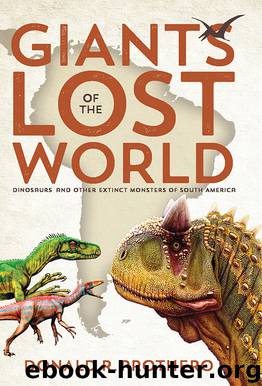
Author:Donald R. Prothero [Prothero, Donald R.]
Language: eng
Format: epub, azw3
ISBN: 978-1-58834-574-5
Publisher: Smithsonian
Published: 2016-10-04T04:00:00+00:00
Figure 6.2. Reconstruction of the gigantic Paleocene Colombian turtle Carbonemys (courtesy @User: AuntSpray/Wikimedia Commons/CC-BY-SA 3.0).
Figure 6.3. The shell of the largest turtle that ever lived, Stupendemys, from Venezuela (courtesy Open-Cage Systems/CC-BY-SA 2.5).
In short, the planet was still very warm, and this favored reptiles, which cannot tolerate extreme cold but do well in tropical climates. The presence of reptiles such as crocodilians, which are very temperature-sensitive, is a good indicator of ancient climate. The occurrence of crocodile fossils above the Arctic Circle in the early Eocene is one of the strongest proofs that polar climate was warm and mild during the greenhouse world. Scientists use the size of reptiles such as snakes and turtles to estimate the temperatures as well, since reptiles grow faster in warmer climates and cannot live at all if it is too cold, since they are cold-blooded. The Cerrejón team estimated the temperature in Colombia in the Paleocene at between 30 and 34°C (86 and 93°F), compared to the average from a modern tropical rainforest, which is only about 28°C (82°F). The atmosphere was also much higher in the greenhouse gas carbon dioxide, another relic of the greenhouse world of the dinosaurs. Based on the leaves and other geological evidence, scientists estimate that the coal swamps of Colombia not only were hotter than the modern rainforests but also experienced 4 meters (13 ft) of rainfall a year, higher than any modern rainforest, the wettest of which sees 250 centimeters (about 8.2 ft) of rain in a typical year!
This greenhouse of the dinosaurs was still very much in effect 20 million years after the non-bird dinosaurs had vanished, making the Paleocene the Planet of the Reptiles. There were large snakes, turtles, and crocodilians on every continent, preying on the smaller, more hapless mammals, and in some places the giant predatory birds ate the mammals as well. It was not until almost 25 million years after the Age of Dinosaurs ended that larger mammals the size of cattle or rhinos finally appeared and began to dominate the planet. But it took a major climate cooling event and mass extinction 37 million years ago, and then another one 33 million years ago, to eliminate the dominance of crocodiles and other reptiles from the Northern Hemisphere. As Stupendemys shows, the tropics of South America still had gigantic turtles even as recently as 5 million years ago.
Using our imaginations, we can picture the dense, humid tropical swamplands in northern Colombia 60 million years ago. The largest creatures were the monster snake Titanoboa and the huge turtle Carbonemys, but the area was also populated by large dyrosaur crocodiles and a diverse assemblage of smaller turtles, crocodiles, fish, lungfish, and amphibians—plus millions of insects, judging by the damage seen on the fossil leaves. No fossil mammals have been found yet at Cerrejón, but elsewhere in South America the Paleocene mammals were no bigger than sheep, and simple plant eaters. They would have been constantly in fear of being eaten by all the predators of this Planet of the Reptiles.
Download
Giants of the Lost World by Donald R. Prothero.azw3
This site does not store any files on its server. We only index and link to content provided by other sites. Please contact the content providers to delete copyright contents if any and email us, we'll remove relevant links or contents immediately.
Sapiens: A Brief History of Humankind by Yuval Noah Harari(14389)
The Tidewater Tales by John Barth(12659)
Mastermind: How to Think Like Sherlock Holmes by Maria Konnikova(7347)
The Thirst by Nesbo Jo(6944)
Do No Harm Stories of Life, Death and Brain Surgery by Henry Marsh(6941)
Why We Sleep: Unlocking the Power of Sleep and Dreams by Matthew Walker(6725)
Life 3.0: Being Human in the Age of Artificial Intelligence by Tegmark Max(5558)
Sapiens by Yuval Noah Harari(5370)
The Body: A Guide for Occupants by Bill Bryson(5096)
The Longevity Diet by Valter Longo(5064)
The Rules Do Not Apply by Ariel Levy(4969)
The Immortal Life of Henrietta Lacks by Rebecca Skloot(4588)
Animal Frequency by Melissa Alvarez(4471)
Why We Sleep by Matthew Walker(4445)
The Hacking of the American Mind by Robert H. Lustig(4383)
Yoga Anatomy by Kaminoff Leslie(4363)
All Creatures Great and Small by James Herriot(4322)
Double Down (Diary of a Wimpy Kid Book 11) by Jeff Kinney(4272)
Embedded Programming with Modern C++ Cookbook by Igor Viarheichyk(4179)
